From Browser to Paperback: How We Made Our First Puzzle Books
Amazon turned down the author of our first book five days before it could go on sale. The author was us.
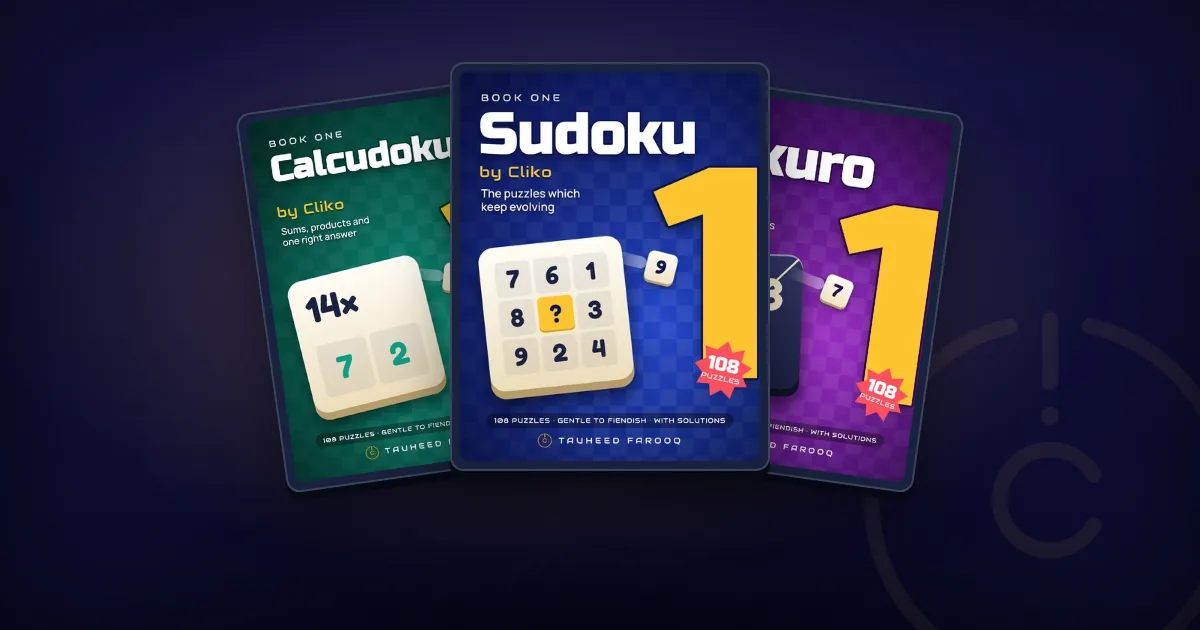
The email that changed the cover
On 24 September, Amazon's publishing team wrote back about our first paperback, Sudoku by Cliko: Book 1. The problem was not the puzzles. It was the name on the cover. We had listed the author as Cliko Games, and their reply was polite and very clear: "Contributors are the people involved in creating your book." A studio is not a person. We had five days to fix it, or the book would not go on sale.
I liked that rule more than I expected to.
So the books now carry a pen name, Tauheed Farooq. It joins my name to my father's, Farooq Ur Rahman. He taught me chess when I was a boy, and a lot of how I think was shaped by the lessons he and my mother taught me. Every book is dedicated to him, right from the cover. The corrected Book 1 went back to Amazon the same day, and on 5 October it was live.
Why paper at all
Cliko started as free puzzle games in a browser, and that is still most of what we do. But a screen is not the only place a puzzle belongs. Some of the best solving I ever did was in printed books, first with the puzzles in newspapers, then with whole puzzle books, long before I played anything online. A pencil does something a touchscreen cannot. You can write a tiny 3 in the corner of a square, cross it out, and see your own doubt on the page.
We started the books because sometimes staying away from the screen is good. But a puzzler has to be with their puzzles, not away from them.
The page at the front of every book says it plainly: we made the games to keep the mind intrigued, and we wanted to do the same offline. The grids come from the same engines that run our online Variant Sudoku, Kakuro and Calcudoku, so you can solve on paper on the subway and carry on at the site when you get home.
Two promises, checked twice
Every book makes the same two promises. Each of its 108 puzzles has exactly one solution, and every one can be finished by reasoning alone, with no guessing. Those are easy sentences to print and surprisingly hard to keep.
Here is how we keep them. The program that builds a puzzle also believes it is correct, and a builder checking its own work proves very little. So a second program, which never sees the first program's answer, reads only the clues exactly as they are printed and counts the solutions itself. If it finds two, the page does not print. For the Calcudoku book that check went as far as matching all 1,791 printed cages, one by one, against what the solver read.
Difficulty gets the same treatment. Each grid is rated by a solver that works one deduction at a time, the way a person does, rather than by how many numbers are given. That is why the six levels (Gentle, Easy, Ordinary, Tricky, Hard and Fiendish) feel like steps and not like cliffs. Each level holds eighteen puzzles. In the Sudoku series, 540 puzzles across five books, no puzzle appears twice and no two finish as the same grid.
What is on a page
A puzzle book is mostly empty space, and the empty space is the part we argued about most. Every grid gets a page of its own on 8.5 by 11 inch cream paper, big enough that a 9 by 9 sudoku has room for pencil marks in every square. At the foot of each page there is a short tip and a line to write down your time, because the only race worth running in a puzzle book is against yourself.
Each level opens with a note that explains what that level will ask of you. In the Sudoku books, Gentle promises that every puzzle falls to the two simplest moves in sudoku. Tricky warns you that "a placement you find early will often unlock nothing for several moves; that is the level working as intended, not a sign you have gone wrong." Fiendish admits that you "may need to hold several possibilities in view at once before one of them collapses." I wanted nobody to reach a hard page and wonder whether they had done something wrong.
Then there is the part I like most, an index we call A Nudge, If You Need One. For every puzzle it names a first move and the kind of move it is, but never the digit. Stuck on a grid? The index might tell you that the square in row 5, column 3 has only one candidate left. It names the square and the kind of move; the digit is yours to find. The full solutions are at the back for when you really are done.
The Kakuro book adds one more thing: a table of every total that appears in it, with the sets of digits that can make each one. Experienced Kakuro solvers carry that table in their heads. Everyone else deserves to have it printed.
Why there is no Kindle edition
People ask. The answer is short: you cannot solve a sudoku on a Kindle.
A Kindle lets you highlight and write notes on text. A puzzle grid is a picture, so there is no square to type a digit into, on any Kindle, in any format. The one format that keeps a 9 by 9 grid intact on the screen is also the one that usually switches note-taking off. So an ebook would sell you a puzzle you cannot actually play, while our website plays the same puzzle for free. I would rather point you to the site than sell you that. If e-readers ever let you write into a grid properly, we will look again.
A line of its own for every book
Each book in a series carries its own subtitle, the one line on the cover that is not the series name. Sudoku Book 1 is The puzzles which keep evolving. Book 2 is 9 digits, a world of amazement. Book 3 is The numbers keep coming, and Book 4 is Solve it one grid at a time. Kakuro Book 1 is Crosswords written in numbers, and Calcudoku Book 1 is Sums, products and one right answer.
They are small things, and they took longer than they should have. Amazon asks that the title, subtitle and author on the cover match the listing exactly, so each line had to be settled before the cover was finished, not after. It is also the only place a series of five similar-looking books gets to say, quietly, that this one is different.
What is out, and what is next
Six books are on Amazon today: Sudoku Books 1 to 4, Kakuro Book 1 and Calcudoku Book 1. Sudoku Book 5 is waiting for its turn, and Books 2 to 5 of Kakuro and Calcudoku are built and queued. Our Amazon account can publish only two new books a week, so they arrive in pairs.
After those come the series we have only drawn so far: Mad Add, a mixed puzzle book, puzzles for kids, and a large-print line. You can see every cover, finished or planned, on our books page. The links there are plain Amazon links, not affiliate links. When you buy a book, the author earns his royalty and nothing else.
And if you would rather not buy anything at all, every one of these puzzles has a free cousin on this site. That was the point from the start.